
Marrying in Scotland from abroad: a practical guide for international couples
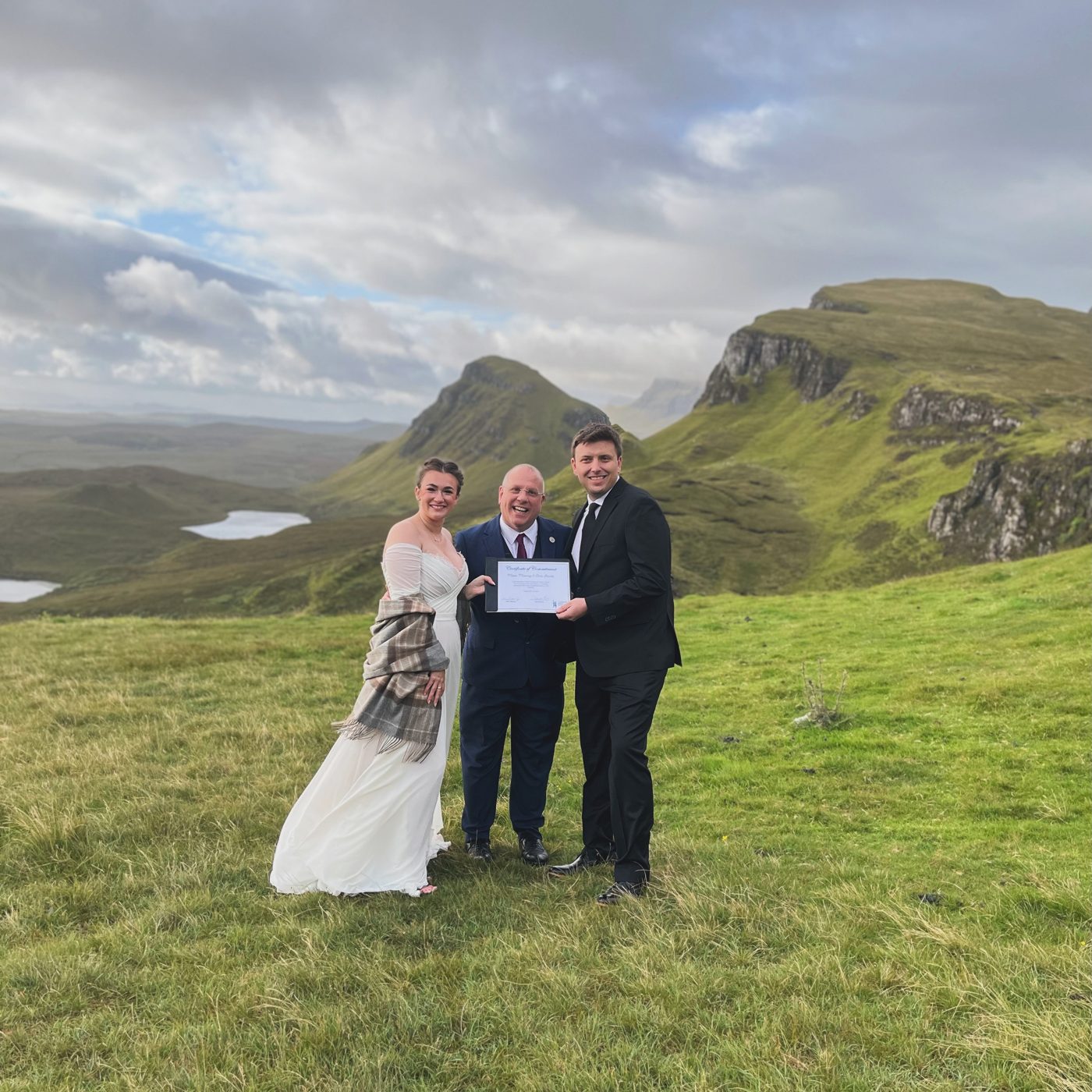
Every year, couples who have never set foot in Scotland decide this is where they want to get married — on a clifftop on Skye, at the foot of a ruined castle, on the shore of a loch that catches the light in a way photographs never quite manage. I've stood with couples on the Quiraing on Skye, wind doing its best to steal the vows out of my hands, and watched them realise mid-ceremony that they picked exactly the right place. Scotland has a way of making itself the reason for the trip, not just the backdrop to it. If you're reading this from Sydney, Toronto, Austin or Auckland and wondering whether you can actually pull off a wedding here, the honest answer is yes — and it's more straightforward than most people expect. This guide covers both halves of that: the real legal groundwork, and the part that gets people dreaming about Scotland in the first place.
The legal basics: no residency requirement, but a real process
Start with the good news, because it surprises a lot of couples: there is no residency requirement to marry in Scotland, whatever passport you hold. You don't need to have lived here, visited before, or have any connection to the country at all. What you do need is to follow the same legal process every couple marrying in Scotland follows — it's just that overseas couples need to build in more lead time.
Each of you submits a Marriage Notice (the M10 form) to the registrar for the district where you're marrying. For couples travelling from overseas, I'd recommend getting this in around 10-12 weeks ahead of the wedding, to leave room for any back-and-forth with the registrar. The absolute legal deadline is 29 days before the ceremony — miss that and the date cannot legally go ahead, so this is the one piece of admin that genuinely cannot slip.
If either of you isn't a UK national, you'll typically also need a Certificate of No Impediment from your home country — essentially official confirmation that there's nothing preventing you from marrying — submitted alongside your M10, with a certified translation if the original isn't in English. UK nationals living abroad don't need this document. It sounds like a lot written out, but in practice it's a handful of forms and a bit of patience with the post. I've written the whole paperwork journey out in detail, start to finish, in my guide to Scottish wedding paperwork — worth reading alongside this one.
Visas: please don't take this section as personalised advice
This is the part I want to get right rather than simple, so bear with me. Visa requirements depend entirely on your nationality, and they change, so treat everything below as a starting point for your own research rather than a rule that applies to you specifically — check gov.uk/marriage-visa and gov.uk/check-uk-visa directly, or speak to a UK immigration adviser, before you assume anything.
A few facts that are true regardless of nationality, though. A Standard Visitor visa does not allow you to marry, register a civil partnership, or even give notice of marriage while you're in the UK on it — that's a hard rule, not a grey area. If you need a visa to enter the UK at all and you're planning to marry while you're here, you generally need to apply for a Marriage Visitor visa instead. As things stand, that visa costs £135, is valid for up to six months, and your wedding has to take place within that window. It doesn't permit you to work or claim public funds, and it doesn't cover dependants — each person would need their own application. You can apply up to three months before your trip, and processing generally takes around three weeks, so build that into your planning alongside your M10 timeline. Irish citizens, and anyone holding EU Settlement Scheme status, are exempt from needing this particular visa.
Where I can help is the wedding itself and the Scottish paperwork that sits around it — what to submit, when, and how the day works legally. Immigration and visa questions are a genuinely different area of expertise, and I'd rather send you to gov.uk or a proper immigration adviser than guess at something that affects whether you're legally allowed into the country. Get that sorted early; everything else in this guide assumes it's in hand.
Will our Scottish marriage be recognised back home in the US?
This is one of the questions I hear most often from American couples, sometimes more than once during planning: will this actually count once we're home? I'm not a lawyer, and this isn't a substitute for checking your own state's specifics, but the short answer is yes. The general rule under US law — set out in the State Department's Foreign Affairs Manual, at 7 FAM 1450 and 7 FAM 1454 — is that a marriage which is legally valid in the place it was performed is recognised as valid in the United States too. The practical requirement, then, is simply that your Scottish wedding is lawfully performed under Scots law, which is exactly what a ceremony led by a Humanist Society Scotland-authorised celebrant, backed by the Marriage Schedule process, provides. As for cost, celebrant fees for 2026 start at £550, which includes two years of HSS membership — roughly $700-750 USD at the time of writing, though naturally that dollar figure moves with the exchange rate on any given day. For the vast majority of couples, that's the whole story: no separate "re-marrying" back home, no second ceremony to make it official, just a valid marriage. If your circumstances are more unusual — a prior marriage not yet fully dissolved, or something specific to your home state's rules — it's worth checking with your own state or a lawyer back home, since state-level quirks do exist. But for the overwhelming majority of couples I marry, a Scottish wedding is simply a valid marriage, full stop.
Why Scotland: the pull of the landscape
Assuming the practicalities are sorted, it's worth pausing on why so many couples choose Scotland over anywhere else, because it's not really about logistics at all. VisitScotland's own research into screen tourism found that roughly one in five UK leisure visitors say they're inspired to visit by Scotland-set film, television or books — and the pull is even stronger among overseas visitors, with 36% of European visitors and 37% of long-haul visitors citing screen tourism, Outlander very much included, as part of what drew them here. It shows up in the numbers on the ground too: real filming locations like Doune Castle, Blackness Castle, Glencoe and Culloden have all seen dramatic rises in visitor numbers over the past decade, as people come to stand in places they first saw on a screen or read about in a book.
For a wedding specifically, it's usually the landscape itself doing the work — the lochs and glens that look almost unreasonably cinematic in person, somewhere between a period drama and an actual place you can stand. It's the single most common thing overseas couples say to me: they want that backdrop, not a recreation of it.
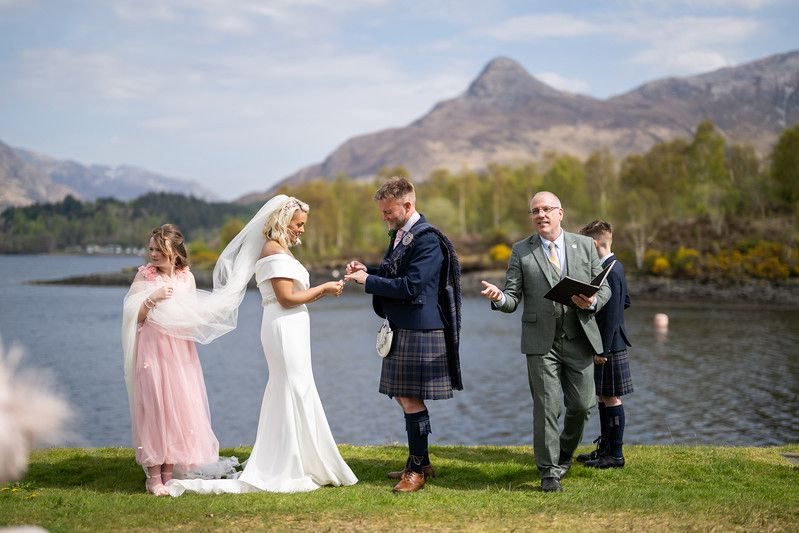
I've married couples on Skye, in glens, and by lochsides where the ceremony genuinely paused for someone to point at the view. If an island or Highland setting is part of the dream, have a look at my guide to eloping in Scotland for how a smaller, landscape-first wedding can work logistically — or, if it's Glencoe specifically pulling at you, my guide to eloping in Glencoe goes into that in more detail. Couples after something quieter and coastal often end up looking at the Isle of Arran, which has its own particular pull for a smaller destination wedding. And if flight logistics matter more than remoteness, marrying on Loch Lomond — under an hour from Glasgow Airport — lets you fly in, marry, and fly out again with barely a night lost either side.
Myths and legends worth weaving into your day
Scotland's folklore gives international couples something no other destination quite offers: a genuine well of stories to draw on for readings, vows or just the mood of the day. A few of the ones couples ask about most. Kelpies — shape-shifting water spirits, usually appearing as horses, said to haunt Scotland's lochs and rivers, luring the unwary onto their backs. Selkies — the seal-folk of Orkney and Shetland legend, who shed their sealskin to walk on land and fall in love, and must choose between the sea and the person they've married. The Loch Ness monster, obviously, because no couple gets through a Scottish wedding without at least one Nessie joke from a guest. And on Skye, the Fairy Pools — named for a Clan MacLeod legend of a chieftain who married a fairy princess, which is about as directly wedding-relevant as folklore gets. None of these need to dominate a ceremony, but a well-placed line about selkies choosing to stay, or a nod to the Fairy Pools if you're marrying near Skye, tends to land better with guests than they expect.
If you want something that goes beyond a line in the script and becomes part of the ceremony itself, a handfasting is the classic choice — a genuinely old Scottish tradition of binding your hands together with ribbon or cord, and one of the most distinctly Scottish things you can build into an international couple's wedding day.
Planning the trip: timing, guests and the practical stuff
Weather-wise, May to September is the mildest and most predictable stretch, which is why it's the busiest season for both venues and celebrants — book early if you want a specific date in that window. That said, weddings happen here year-round, and a Scottish winter wedding has its own particular magic if you don't mind the cold and the early dark — I've written about what that actually involves in my guide to winter weddings in Scotland.
For overseas couples, I'd suggest starting the search for a celebrant and venue 12-18 months out if you have a specific date or a sought-after location in mind — the well-known spots and the celebrants who know them get booked well ahead. Keep your guest list realistic, too: every person you invite is someone booking flights and time off work, so smaller, considered lists tend to serve destination weddings better than trying to replicate a home-country guest count. And on the legal side, Scotland doesn't set a minimum or maximum number of guests, and there's no nationality requirement for your witnesses — you just need two witnesses, aged 16 or over, and they can be anyone you choose.
Want to talk it through? Planning your wedding in Scotland from abroad? I've married couples from across the world — happy to talk through timings, paperwork and what's realistic for your dates.
Check my date