
LGBTQ+ humanist ceremony ideas: readings, rituals and stories
I've written a fair number of these ceremonies now, and the question I get asked most by LGBTQ+ couples isn't "is this legal" or "will people mind" — it's a quieter one, usually asked a few weeks into planning, once the excitement has settled and the reality of the day has started to sink in: does this actually have to look like every wedding we've ever been to? And the honest answer is no. Not one bit of it. I've already written about the why of doing this with me — this post is the how. Concrete ideas, gathered from actually standing at the front of these ceremonies, for building a day that sounds like you and nobody else.
Start from your relationship, not from a script
Most wedding tradition was built with a specific pair of roles in mind, and if you don't fit those roles, following the script by default just imports assumptions you never agreed to. So we don't start with a template and edit it. We start with your relationship — who proposed, who's the planner and who's the disaster, what you actually call each other at home — and build the ceremony out from there. That might mean two grooms, two brides, partners who don't use either word, or language that doesn't sort you into roles at all. Nobody has to walk down an aisle if you'd rather walk in together. Nobody has to be given away unless that moment genuinely matters to you both. I ask, I listen, and then I write it in your words — never "bride and groom" on autopilot because that's what the software expected.
Choosing rituals that mean something, not ones that came with the venue
Scotland has a brilliant back catalogue of ceremony rituals — a handfasting, a quaich, a ring warming, an oathing stone — and every single one of them belongs to you as much as anyone else getting married in this country. But the point isn't to bolt one on because it looks good in photos. The best moments I've built with LGBTQ+ couples have usually come from asking a slightly different question: what's a piece of your actual story that deserves a physical moment in the ceremony? I've used a handfasting cord in the colours of a couple's first flat. I've had rings carried in by a dog because the dog came first, before either partner was ready to admit the relationship was serious. None of that is in any book of ritual — it's just what fit.
Readings and words that sound like you, not a stranger
I keep a working shortlist of readings that land well out loud (I've written more on choosing wedding readings if you want the fuller list), but for LGBTQ+ couples specifically, the best source material is often not a famous poem at all. It's a passage from a favourite queer novel, a verse that quietly got you both through a hard year, the lyric of a song that was playing the night you met, or something one of you wrote in a text message that the other one kept. Some couples do want a beautiful, well-loved poem read by a friend with a shaking voice — and that's completely right too. The only rule I hold couples to is this: read it out loud before you commit to it. A reading that moves you on the page and a reading that survives being spoken to a room of eighty people are not always the same thing, and I'll help you test both before the day.
Chosen family, given a proper job to do
For plenty of LGBTQ+ couples, the people who matter most on the day aren't only the ones related by blood — they're the friends who showed up when it counted, sometimes instead of family, sometimes alongside them. A humanist ceremony has no fixed guest list of "who's allowed to do what", so chosen family can hold exactly the roles that matter: walking you in, reading, holding the rings, standing as your legal witnesses, giving a short address instead of a traditional parent's speech. I've married couples where the person giving them away was a best friend of fifteen years, and it was, without question, the right call for that room. We simply build the ceremony around who your people actually are.
Chris & David, House for an Art Lover
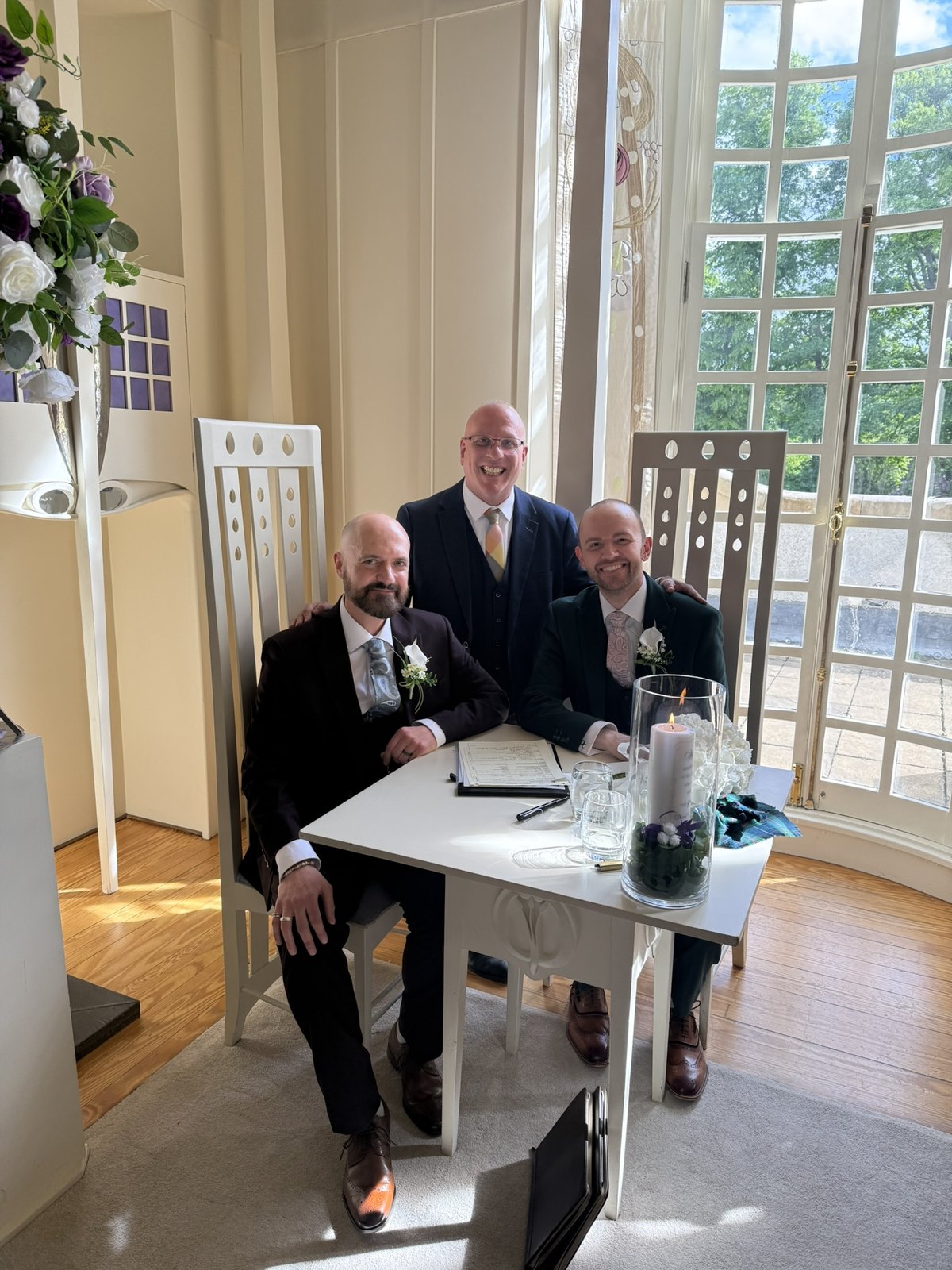
I'll tell you about one wedding rather than talk in the abstract, because it says more than any list of tips could. Chris and David met around the year 2000 in a call centre, and it took them twenty-five years to get from there to a Mackintosh music room at House for an Art Lover in Glasgow, where I had the honour of marrying them — husband and husband, in front of everyone they love. There was a handfasting. There were secrets read aloud that only the two of them fully understood. The rings arrived on the collar of a Jack Russell called Bella Ciao, who took the job far more seriously than the job required. Nothing about that ceremony was generic, and nothing about it was borrowed from a template built for someone else's wedding. It was built for two men who've known each other a quarter of a century, and it showed. That's the whole idea of this post: your ceremony can be that specific, that joyful, and that entirely yours.
Legally married, built for you from the start
Every one of these ideas sits inside a ceremony that's fully legally binding in Scotland — Humanist Society Scotland celebrants were conducting some of the country's first same-sex weddings the moment equal marriage arrived here, so this has never been an afterthought bolted onto a straight tradition. If you'd like to see how other LGBTQ+ couples have built their days, my LGBTQ+ wedding celebrant page has more, and my testimonials are worth a read if you want to hear it from couples rather than from me. If you're weighing up what any of this costs, I've laid it out plainly on my wedding cost page — no surprises, no premium for being who you are.
Planning an LGBTQ+ humanist wedding? Tell me a bit about your relationship and what you're picturing for the day — I'll come back with honest thoughts on rituals, readings and how we'd build it together.
Check my date