
Interfaith & multicultural weddings: how a humanist ceremony blends traditions
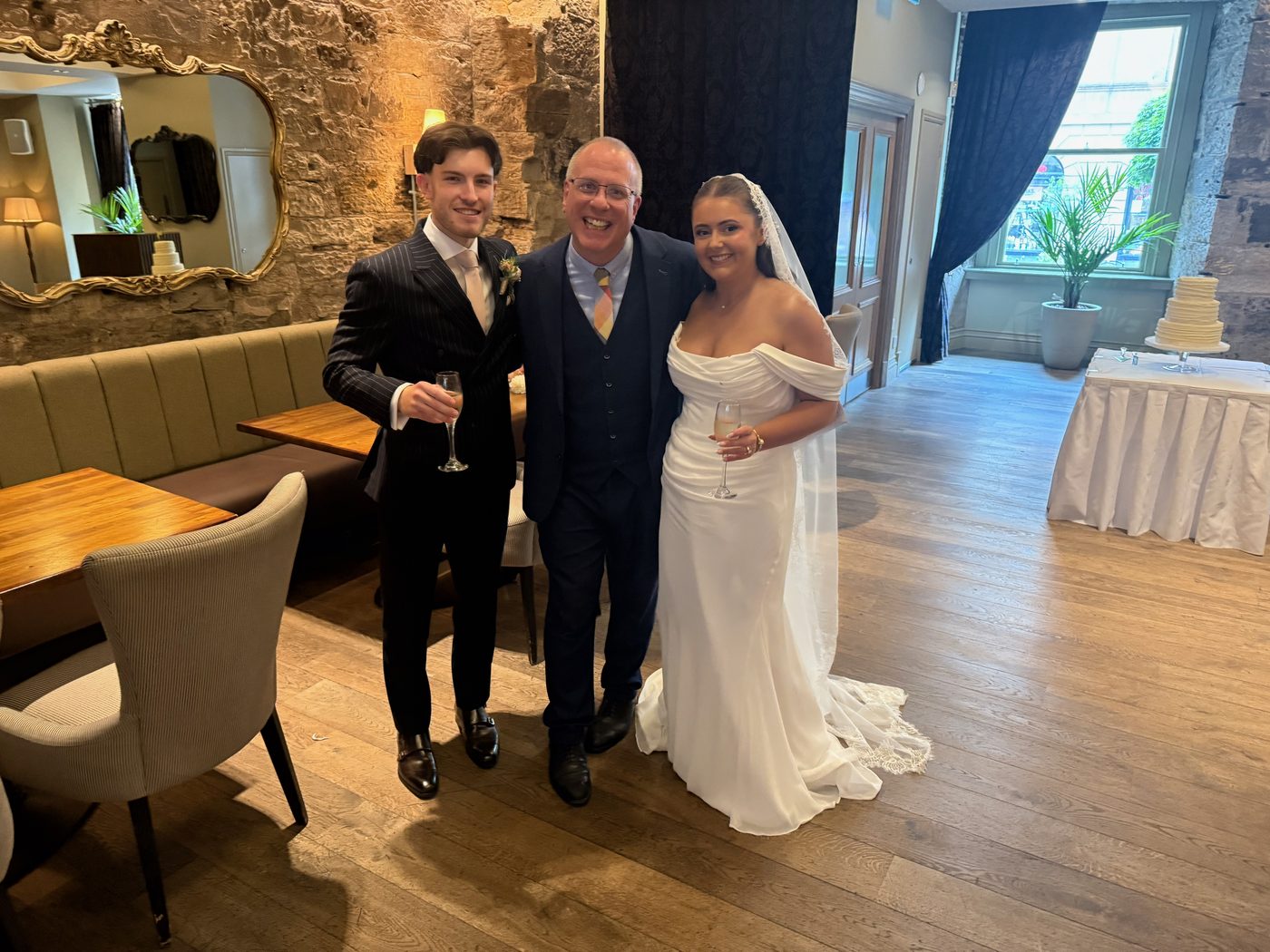
A humanist ceremony holds no religious content of its own. There's no liturgy sitting underneath it that has to be worked around, no fixed order of service handed down from an institution, no set of words that are "supposed" to be there. That sounds, on paper, like a ceremony that has less to offer a couple with a strong faith or cultural background. In practice it's almost the opposite. Because nothing has to be stripped out to make room for something else, a humanist ceremony is one of the easiest ceremony types there is to genuinely blend two — or three, or four — sets of traditions into one script, with nobody's family feeling like a guest in someone else's ceremony.
I get asked about this often: couples where one partner is Catholic and one is Sikh, one is Jewish and one has no faith at all, one grew up going to the kirk every Sunday and the other grew up with a completely different set of family customs from another country entirely. The question underneath all of it is usually the same — can we actually have both, properly, rather than one tradition politely hosting the other? With a humanist ceremony, the honest answer is yes.
Why humanist ceremonies work well for interfaith and mixed-heritage couples
A religious ceremony, by its nature, has a structure that belongs to that religion. Even when a minister or officiant is generous and accommodating, an interfaith element still has to be fitted into someone else's service — a reading here, a moment there — because the underlying shape of the ceremony was never designed to hold more than one tradition at once. That's not a criticism of religious ceremonies; it's simply what they are. They belong to something specific, and rightly so.
A humanist ceremony starts from a blank page. It's written from scratch, around you as a couple, with no fixed liturgy to negotiate with. That means there's no "host" tradition and no "guest" tradition. If a handfasting from one partner's Scottish heritage and a tea ceremony from the other partner's family both matter, they can both go in — not as one interrupting the other, but as two elements sitting side by side on genuinely equal footing. The ceremony bends to fit the couple and their families, rather than the couple and their families having to bend to fit the ceremony.
Scottish rituals that sit alongside other traditions, not instead of them
Scotland has its own set of ceremony traditions that, handily, are just as flexible as the humanist format itself. They're not religious rites — they're old customs, which means they drop in comfortably next to a tradition from any other culture without any sense of competition between them.
Handfasting is the old Scottish binding-of-hands ritual, where ribbon or cord is wrapped around the couple's joined hands — it's visual, it's rooted in this country, and it works beautifully placed right alongside a ritual from anywhere else in the world, rather than replacing it. The quaich, or "loving cup," is a shared toast from a two-handled vessel that both families can take part in — a lovely, low-key way of bringing two families into the same physical moment. And the oathing stone is a simple, grounded tradition where the couple make their vows with hands resting on a stone, echoing the old idea of a promise made on solid ground.
None of these need to stand in for a couple's own family or cultural rituals — a tea ceremony, a unity candle or sand ritual from another tradition, a blessing spoken by an elder, or readings and vows given in more than one language if that matters to the families involved. They can all appear in the same ceremony, one after another, each given its own proper moment rather than being squeezed in as an afterthought.
Practical advice for planning a blended ceremony
A few things make this kind of ceremony go smoothly, in my experience:
Involve both families early. The earlier both sides are part of the conversation, the fewer surprises there are later, and the more it feels like a ceremony built with everyone rather than presented to them as a finished plan.
Decide together what's essential and what's optional. Not every custom either family has ever practised needs to make the final cut. Working out, as a couple, which elements truly matter and which are nice-to-haves makes the rest of the planning far easier — and takes the pressure off trying to include absolutely everything.
Consider more than one language, if it matters to the families. A short blessing, a reading, or even just a line of the vows spoken in a language that matters to one side of the family can carry real weight on the day, even for guests who don't understand every word of it.
Don't aim for a strict 50/50 split. Couples sometimes assume fairness means equal minutes for each tradition. It doesn't. The right balance is whatever reflects what matters most to the two of you — that might be mostly one tradition with a smaller, well-placed nod to the other, or it might be a genuinely even blend. There's no formula; there's just what feels true to your relationship. If you want a wider sense of how humanist ceremonies use readings and words more generally, my piece on choosing readings for a humanist wedding covers that in more depth.
It's not only about faith — it's about expectations too
"Interfaith" and "multicultural" cover a lot of ground, but blending traditions isn't only about religion or country of origin. It also comes up with same-sex couples navigating two families' different expectations of what a wedding "should" look like, or couples where one family has very traditional ideas about a ceremony and the other has none at all. The underlying skill is the same in every case: a good celebrant asks questions rather than assumes. What matters to your mum might not be what matters to his dad, and neither of those things has to be guessed at — they can simply be asked about, early, and built in properly.
Legally binding, whatever traditions are woven in
Whatever mix of rituals, languages or family customs end up in your ceremony, none of it affects the legal side of things. A humanist wedding conducted by a celebrant authorised by Humanist Society Scotland is fully and legally binding in Scotland, exactly the same as any other legally recognised ceremony — the blending is entirely about how the ceremony feels, not about its legal standing. If you want the detail on how that paperwork actually works, I've written more in what the wedding paperwork actually involves.
Want to talk it through? Blending two families, two faiths, or two cultures into one ceremony? That's exactly the kind of conversation I love having — let's talk about what matters most to both of you.
Check my date