
Humanist wedding myths, busted
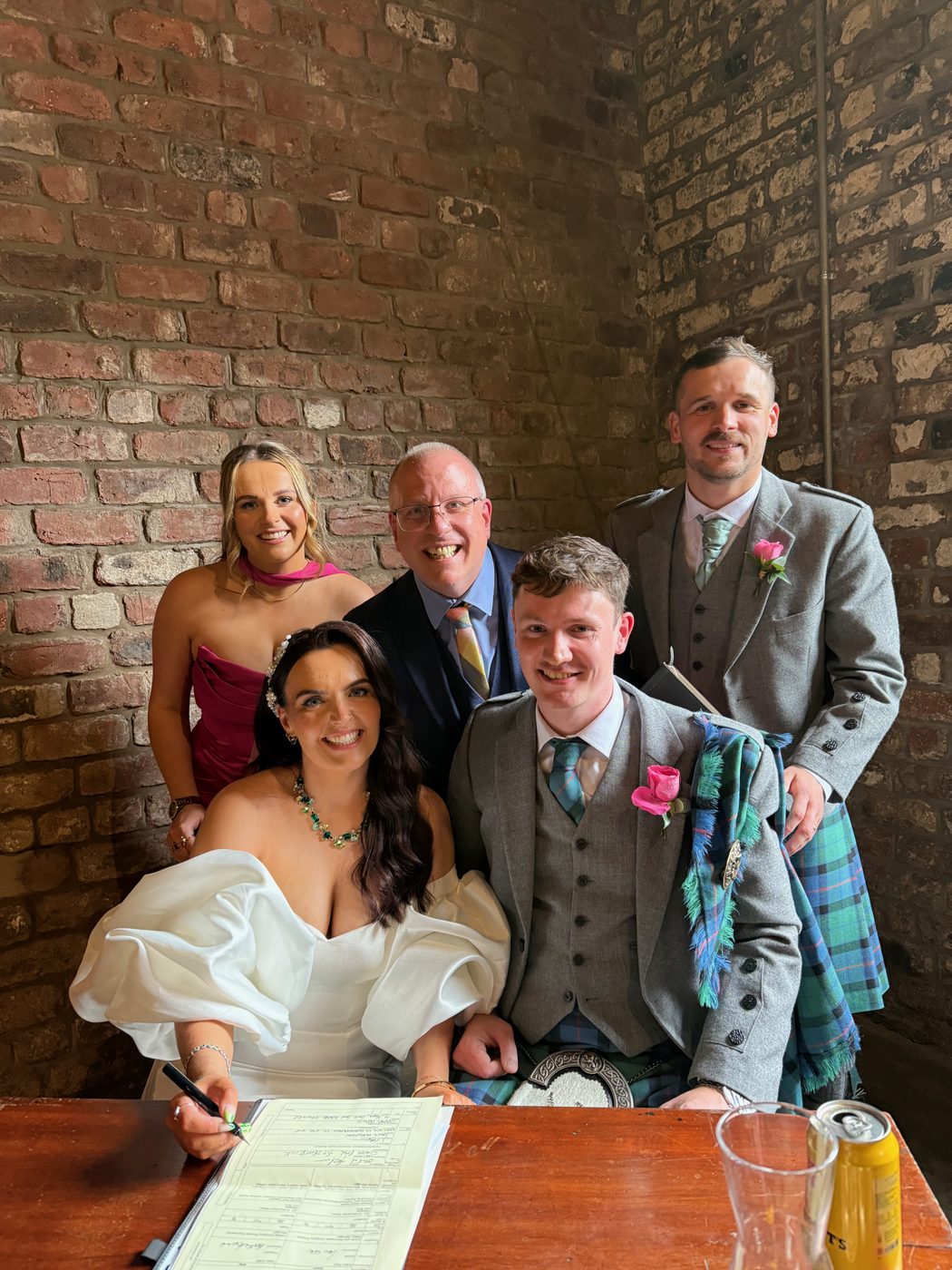
I get the same handful of misconceptions in almost every first conversation I have with a couple, usually delivered with a slightly apologetic "this might be a daft question." It isn't daft at all — humanist weddings are still fairly new to a lot of people, and most of what folk think they know comes from a wedding they went to twenty years ago, or a church they grew up in, or just a guess. So let's go through the big ones properly, myth by myth, and get you the actual answers.
Myth: humanist weddings aren't legally binding
Reality: they absolutely are. Humanist marriages have been fully legally binding in Scotland since 2005 — Scotland was the first place in the UK to do this, and it's part of why humanist weddings here now outnumber religious ones. There's no separate trip to the registrar's office required, no "the real wedding was actually the day before at the town hall." You give notice to the registrar, I write and lead your ceremony, you sign the Marriage Schedule with your witnesses on the day, and that's it — married, properly, in the eyes of the law. I've written about exactly how the legal side works in what actually happens at a humanist wedding and in more depth in humanist weddings and the law, if you want the detail. (Worth flagging for anyone reading from south of the border: this legal status is specific to Scotland — humanist weddings still aren't legally binding in England and Wales.)
Myth: humanist means anti-religious, so you can't include anything religious
Reality: humanist means non-religious, not anti-religious, and that distinction matters. A humanist ceremony isn't built around a religious framework and I won't be reciting scripture or invoking a god — that's the "non-religious" bit doing its job. But if a family tradition matters to you, if there's a reading or a blessing or a moment that nods to a parent's faith, we can absolutely find a respectful way to include it. What we're not doing is having the ceremony's meaning dictated by doctrine you didn't choose. The test I use is simple: does this matter to you and your relationship? If yes, it has a place. Humanism, for what it's worth, is about finding meaning and morality in this life and in each other, without needing a religious structure to supply it — which is exactly why it flexes to hold whatever's genuinely meaningful to you.
Myth: you have to be an atheist to have a humanist wedding
Reality: no belief test, no membership card required. Couples who choose a humanist ceremony come from every kind of background — some are committed atheists, plenty are quietly agnostic, some grew up religious and have drifted, some still hold a faith privately but don't want their wedding to be a religious service. What they all have in common isn't a shared belief system, it's wanting a ceremony about their actual relationship rather than a set liturgy. If that's what you're after, a humanist wedding is for you, whatever box you would or wouldn't tick on a form.
Myth: a humanist ceremony is somehow less "proper" than a religious or civil one
Reality: it carries exactly the same legal weight. In the eyes of Scots law, a humanist marriage is every bit as official as one conducted in a church or by a council registrar — same Marriage Schedule, same signatures, same standing at the end of it. What differs isn't properness, it's personalisation: a civil ceremony follows a fixed legal structure, a religious ceremony follows a fixed liturgy, and a humanist ceremony is written from scratch around your story. I go through exactly where the real differences lie — who leads it, what it can include, how it's built — in humanist vs civil ceremony in Scotland. More personal has never meant less official.
Myth: it has to happen in a certain kind of venue
Reality: a humanist wedding can legally take place absolutely anywhere in Scotland — there's no requirement for a licensed building at all. I've married couples on beaches, up hillsides, in barns, in back gardens, in marquees, in the function room of a pub that meant something to them. If a place has your history in it, or your family's, or simply the view you want to remember standing in front of, that's reason enough. The only planning question is practical — weather, access, timings — never legal.
Myth: you can't have traditional elements like being walked down the aisle
Reality: humanist weddings aren't anti-tradition, they're pro-choice. If you want to be walked down the aisle, if you want a first look, if you want your granny's handkerchief tucked into your bouquet or a hymn your family has always sung, we build it in. The whole point of a humanist ceremony is that nothing is included by default and nothing is excluded by default — every single element is there because it means something to you, not because tradition or a template demanded it. You keep what you love and lose only what never felt like you in the first place.
Still got a myth you want busted, or a question nobody's answered yet? Ask me directly — I'd rather clear it up now than have it niggle at you later. And if you've more questions about how the day actually runs, my FAQ page covers the rest.
Check my date